GST Registration Cancellation: New Automatic Cancellation Rules Effective from 1 December 2026
The Central Board of Indirect Taxes and Customs (CBIC) has introduced significant changes to the procedure for cancellation of GST registration under the Central Goods and Services Tax (CGST) Rules, 2017. The new amendment provides for automatic electronic cancellation of GST registration through the GST common portal, subject to fulfilment of prescribed return-filing and payment conditions.
The amendment has been notified by the Ministry of Finance vide Notification No. 08/2026–Central Tax dated 25 November 2026, introducing the Central Goods and Services Tax (Second Amendment) Rules, 2026.
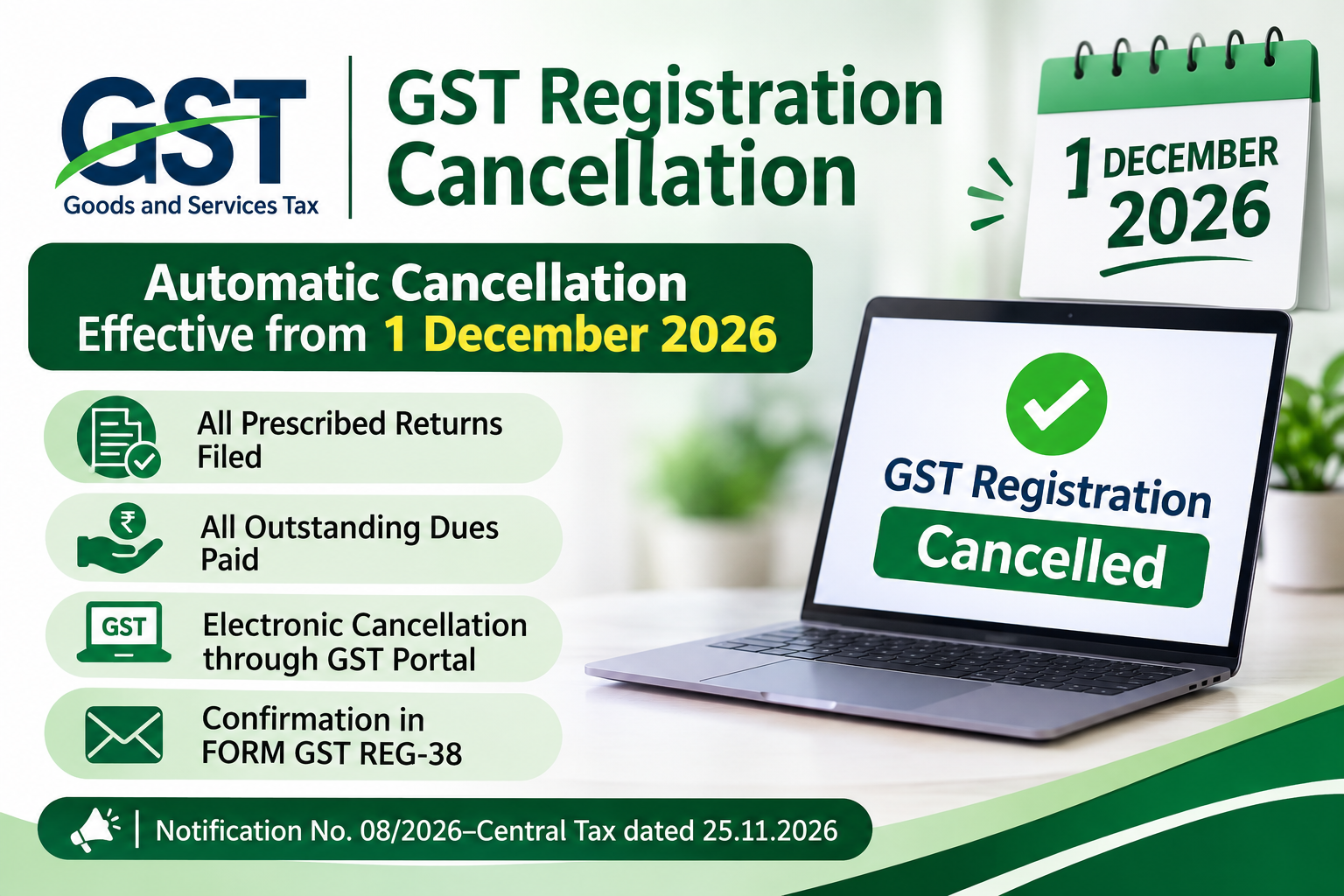
The amended provisions will come into effect from 1 December 2026 and are aimed at simplifying the GST registration cancellation process by reducing manual intervention in eligible cases.
1. What Is the New GST Registration Cancellation Rule?
The amendment substitutes sub-rules (5) and (6) of Rule 20 of the CGST Rules, 2017, which deal with cancellation of GST registration on the request of a registered taxpayer.
Under the revised provisions, GST registration will be cancelled electronically through the common GST portal if the taxpayer fulfils the prescribed compliance requirements and clears all outstanding liabilities.
This means that eligible cancellation applications will no longer require routine manual examination by the jurisdictional GST officer.
The cancellation will take effect from the date requested by the taxpayer and will be communicated electronically through FORM GST REG-38.
2. Conditions for Automatic Cancellation of GST Registration
As per the amended Rule 20(5), automatic electronic cancellation of GST registration will be available subject to fulfilment of the following conditions:
A. Filing of Prescribed GST Returns
The taxpayer must have furnished the returns referred to in Rule 20(2) and Rule 20(3) within the timelines specified under the respective provisions.
B. Payment of Outstanding GST Liabilities
All outstanding amounts payable by the taxpayer must have been discharged, including:
- Outstanding GST tax liability
- Interest payable under GST law
- Applicable fees
- Penalties
- Any other amount legally payable
C. Submission of Cancellation Application
The taxpayer must submit an application for cancellation of GST registration under Rule 20(1) through the prescribed procedure.
Once these conditions are satisfied, the GST common portal will electronically cancel the registration with effect from the date from which cancellation has been requested.
3. What Happens If GST Returns Are Pending or Dues Are Unpaid?
The amended Rule 20(6) specifically addresses cases where taxpayers have not fulfilled the prescribed compliance requirements.
Where the applicable returns or statements, including FORM GST CMP-08, wherever applicable, have not been furnished, or any outstanding tax, interest, fee, penalty or other amount remains unpaid, the cancellation application will be forwarded to the proper officer for examination.
Accordingly, the amended provisions establish two different routes for processing GST cancellation applications:
- Compliant taxpayers: Electronic cancellation through the GST common portal.
- Non-compliant taxpayers: Application forwarded to the proper officer for examination.
Therefore, taxpayers should ensure that all applicable returns are filed and outstanding liabilities are settled before applying for cancellation of GST registration.
4. Cancellation of GST Registration Through FORM GST REG-38
One of the important aspects of the amended provisions is the electronic communication of cancellation through FORM GST REG-38.
Where the prescribed conditions are satisfied, the common portal will electronically cancel the GST registration and communicate the cancellation to the registered taxpayer through FORM GST REG-38.
The effective date of cancellation will be the date from which cancellation has been sought in the application.
This system-based mechanism is expected to make the cancellation process more efficient and reduce procedural delays in eligible cases.
5. Old vs New GST Registration Cancellation Procedure
| Particulars | Amended Provision |
|---|---|
| Applicable Rule | Rule 20(5) and Rule 20(6) |
| Effective Date | 1 December 2026 |
| Mode of Cancellation | Electronic cancellation through GST portal |
| Return Filing | Prescribed returns must be furnished within specified timelines |
| Outstanding Dues | All payable liabilities must be discharged |
| Cancellation Communication | FORM GST REG-38 |
| Pending Returns or Unpaid Dues | Forwarded to proper officer for examination |
6. Practical Impact on Businesses and Taxpayers
The revised GST registration cancellation procedure is an important step towards greater automation of GST administration.
Businesses that have discontinued operations, closed their establishments, transferred their businesses or otherwise become eligible for cancellation of GST registration may benefit from a simplified cancellation mechanism.
However, taxpayers should consider the following points before submitting their cancellation applications:
- Reconcile all pending GST returns and ensure that prescribed returns have been furnished.
- Verify the electronic liability ledger and clear all outstanding tax, interest, fees and penalties.
- Ensure that applicable statements, including CMP-08, have been filed wherever required.
- Carefully select the proposed effective date of cancellation.
- Retain the cancellation acknowledgement and electronic communication issued through the GST portal.
Timely compliance will help taxpayers avoid unnecessary examination and delays in processing their cancellation applications.
7. Conclusion
The amendment to Rule 20 of the CGST Rules, 2017, introduces a simplified and technology-driven mechanism for cancellation of GST registration.
With effect from 1 December 2026, eligible applications will be processed electronically through the common GST portal, provided the prescribed returns have been filed and all outstanding liabilities have been discharged.
Applications involving pending returns or unpaid dues will continue to be examined by the proper officer.
Businesses planning to discontinue their GST registration should review their pending compliances and outstanding liabilities to take advantage of the revised electronic cancellation process.
Legal Reference: Notification No. 08/2026–Central Tax dated 25 November 2026 – Central Goods and Services Tax (Second Amendment) Rules, 2026.
Frequently Asked Questions (FAQs)
Q1. From when will the new GST registration cancellation rules apply?
The amended provisions of Rule 20(5) and Rule 20(6) will be effective from 1 December 2026.
Q2. Will GST registration be cancelled automatically after submitting the application?
Automatic electronic cancellation will be available where the prescribed returns have been furnished within the specified timelines and all outstanding liabilities have been paid.
Q3. What happens if GST returns are pending at the time of cancellation?
If the prescribed returns or applicable statements have not been furnished, the cancellation application will be forwarded to the proper officer for examination.
Q4. Is payment of outstanding GST dues mandatory before cancellation?
Yes. All outstanding tax, interest, fees, penalties and other amounts payable must be discharged for electronic cancellation under the amended Rule 20(5).
Q5. Which form will be issued for electronic cancellation of GST registration?
The cancellation communication will be issued electronically in FORM GST REG-38.
Q6. Which provision governs cancellation of GST registration on the taxpayer’s request?
Rule 20 of the CGST Rules, 2017, governs cancellation of registration on the request of a registered taxpayer.
Disclaimer: This article is intended for general informational purposes and should not be construed as professional or legal advice. Taxpayers should refer to the applicable statutory provisions and notifications before taking any action.