Switched Jobs During the Financial Year? Here’s Everything You Need to Remember While Filing Your ITR
Changing jobs can be a significant career milestone, but it can also make your Income Tax Return (ITR) filing more complicated. If you have worked with two or more employers during a financial year, overlooking certain tax implications can result in incorrect tax calculations, additional tax liability, notices from the Income Tax Department, or delayed refunds.
As the ITR filing season approaches, here is a comprehensive guide on what salaried employees should keep in mind after switching jobs.
Why Does a Job Change Impact Your ITR?
When you switch employers during a financial year, your salary is paid by multiple employers. Each employer deducts TDS based on the salary paid by them and the information available to them. If your new employer does not consider your previous salary income, there may be a shortfall in tax deduction, leading to additional tax payable at the time of filing your return.
Therefore, the responsibility of correctly reporting total income and taxes ultimately rests with the taxpayer.
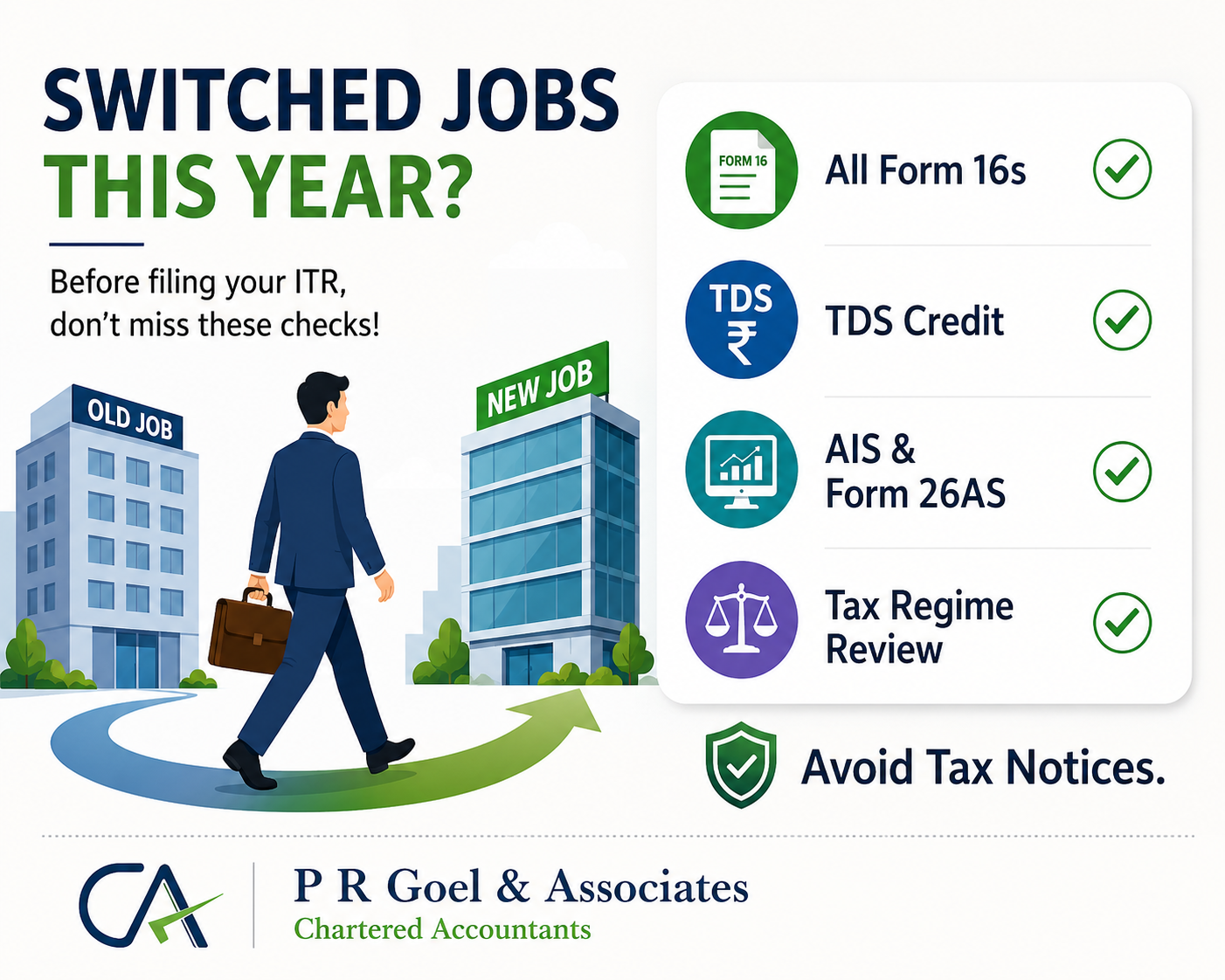
1. Collect Form 16 from All Employers
One of the first steps before filing your ITR is obtaining Form 16 from every employer you worked with during the financial year.
Each Form 16 contains:
- Salary paid by the employer
- Tax deducted at source (TDS)
- Exemptions and deductions considered by the employer
- Taxable income computation
If you switched jobs during the year, relying only on the latest employer’s Form 16 can lead to under-reporting of income.
2. Report Salary from Every Employer
A common mistake among salaried taxpayers is reporting salary income from only the current employer.
While filing your ITR, ensure that you include:
- Salary from your previous employer
- Salary from your current employer
- Bonuses and incentives
- Any arrears or other employment-related income
Failure to disclose income from a previous employer can create discrepancies and may attract scrutiny from the tax department.
3. Watch Out for Duplicate Deduction Claims
This is one of the most overlooked issues after a job switch.
Many employees submit investment declarations to both employers. As a result, deductions such as Section 80C, House Rent Allowance (HRA), or other exemptions may get considered twice while calculating TDS.
However, while filing your ITR, deductions can only be claimed up to the prescribed limits. Claiming the same deduction twice can result in additional tax demands and interest. Carefully recompute your eligible deductions before filing your return.
4. Reconcile AIS, Form 26AS and Form 16
Do not rely solely on Form 16.
Before filing your return, reconcile your income and TDS details with:
- Annual Information Statement (AIS)
- Form 26AS
- Salary records and payslips
- Form 16 issued by all employers
This helps identify:
- Missing salary entries
- Unclaimed TDS credits
- Reporting mismatches
- Incorrect tax calculations
Tax professionals strongly recommend this reconciliation exercise to avoid future notices and refund delays.
5. Review Your Tax Regime Selection
A higher salary after switching jobs may alter the tax efficiency of your chosen tax regime.
Before filing your ITR, compare:
- Old Tax Regime
- New Tax Regime
Consider factors such as:
- Section 80C investments
- Medical insurance deductions under Section 80D
- Home loan benefits
- HRA exemption
- NPS contributions
A proper comparison can significantly reduce your tax liability. Salaried individuals generally have the flexibility to choose the most beneficial regime while filing their return.
6. Check for Additional Tax Liability
If your new employer did not consider income earned from your previous employer, the total TDS deducted during the year may be insufficient.
In such cases:
- Compute your final tax liability
- Verify total TDS available
- Pay Self-Assessment Tax, if required
Failure to pay the shortfall may result in interest under the Income Tax Act.
7. Choose the Correct ITR Form
While filing your return, ensure that you select the correct ITR form based on your income profile.
Using an incorrect form can lead to a defective return and unnecessary compliance issues. Taxpayers should review all income sources before selecting the applicable ITR form.
Common Mistakes to Avoid After Switching Jobs
Avoid these frequent errors:
- Reporting salary from only one employer.
- Ignoring Form 16 from a previous employer.
- Claiming deductions twice.
- Not reconciling AIS and Form 26AS.
- Failing to review tax regime options.
- Missing additional tax liability due to lower TDS deduction.
- Selecting the wrong ITR form.
Final Thoughts
Switching jobs during the financial year requires extra attention while filing your Income Tax Return. The key is to consolidate income from all employers, verify TDS credits, avoid duplicate deduction claims, and reconcile information with AIS and Form 26AS.
A little extra diligence can help you avoid notices, penalties, and refund delays while ensuring a smooth and accurate ITR filing experience.
Need Assistance with ITR Filing?
If you have switched jobs during the year and are unsure about tax calculations, TDS reconciliation, or tax regime selection, our team at P R Goel & Associates can help you file your return accurately and maximize eligible tax benefits.