Metro Rail Introduced as an Additional Mode of Transport in the E-Way Bill System
GST UPDATE | NOVEMBER 2026
Effective Date: 1 November 2026
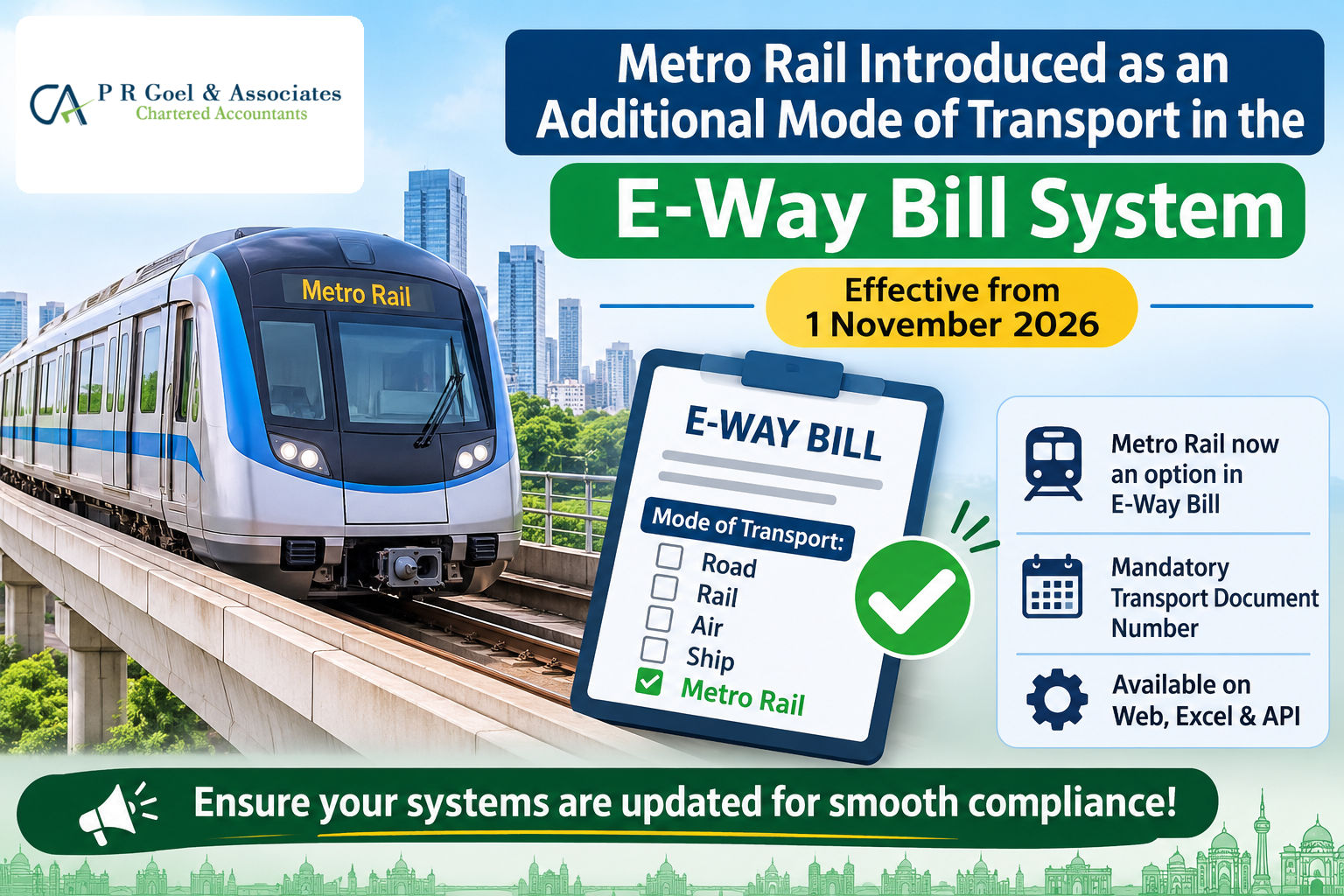
The Goods and Services Tax Network (GSTN) has introduced Metro Rail as an additional mode of transportation in the E-Way Bill system, providing taxpayers and transporters with another option for reporting the movement of goods under GST.
This development follows the issuance of Notification No. 05/2026–Central Tax dated 26 October 2026, which amended the Central Goods and Services Tax (CGST) Rules, 2017, with effect from 1 November 2026.
Subsequently, GSTN issued an advisory dated 20 November 2026, announcing the availability of the Metro Rail option on the E-Way Bill portal.
The amendment is intended to align the E-Way Bill system with the evolving transportation infrastructure and facilitate the proper reporting of goods transported through Metro Rail networks.
1. Metro Rail Added as a New Mode of Transportation
Prior to this amendment, the E-Way Bill system provided the following modes of transportation:
- Road
- Rail
- Air
- Ship
With the inclusion of Metro Rail, the E-Way Bill system now provides five modes of transportation.
Taxpayers and transporters can select Metro Rail whenever goods are transported through a Metro Rail network, instead of selecting an unrelated transportation mode.
This facility is particularly relevant for businesses and logistics operators using Metro Rail infrastructure for the movement of goods.
2. Legal Amendment Under the CGST Rules, 2017
The amendment has been introduced through Notification No. 05/2026–Central Tax dated 26 October 2026.
Through this notification, Metro Rail has been included under Rule 138(2A) of the CGST Rules, 2017, relating to the modes of transportation recognised under the E-Way Bill framework.
The amendment has become effective from 1 November 2026.
Accordingly, the E-Way Bill portal has been updated to incorporate Metro Rail as an additional transportation option.
3. Functionalities Where Metro Rail Option Is Available
As per the GSTN advisory dated 20 November 2026, the Metro Rail option has been enabled for the following functionalities:
| Functionality | Availability |
|---|---|
| E-Way Bill Generation | Enabled |
| Part-B Update | Enabled |
| Vehicle Update | Enabled |
| Consolidated E-Way Bill Generation | Enabled |
| Consolidated E-Way Bill Re-generation | Enabled |
The facility has been made available through the Web, Excel and API interfaces, subject to the deployment status explained below.
4. Mandatory Entry of Transport Document Number
One of the important compliance requirements introduced with this facility is the mandatory entry of the Transport Document Number.
Whenever a taxpayer or transporter selects Metro Rail as the mode of transportation, entering the Transport Document Number becomes compulsory.
Taxpayers and transporters must ensure that:
- Metro Rail is selected as the appropriate mode of transportation.
- The correct Transport Document Number is entered.
- All other relevant transportation details are properly furnished before submission.
Therefore, businesses should maintain appropriate transportation records and ensure that the document number is correctly captured while generating or updating the E-Way Bill.
5. Availability on the E-Way Bill Portal
GSTN has clarified the deployment status of this facility for different categories of users.
A. Web Portal Users
The Metro Rail facility is already available in the Production environment for users accessing the E-Way Bill portal directly.
Taxpayers and transporters can use this option while generating E-Way Bills and updating transportation details.
B. API Users
For businesses and transporters using API-based integration with the E-Way Bill system, the functionality has currently been released in the Sandbox environment.
API users are required to:
- Make the necessary changes in their existing software systems.
- Integrate the Metro Rail transportation option.
- Conduct the required testing in the Sandbox environment.
- Validate the functionality before its rollout in the Production environment.
GSTN will separately communicate the availability of this functionality in the API Production environment.
6. Impact on Taxpayers and Transporters
The introduction of Metro Rail as an additional mode of transportation is an important development for businesses involved in goods movement through urban transportation networks.
The key implications are as follows:
1. Correct Reporting of Transportation Mode: Businesses must select Metro Rail wherever goods are transported through Metro Rail services.
2. Better Transportation Documentation: The mandatory Transport Document Number will help ensure that transportation details are properly recorded in the E-Way Bill system.
3. Software and ERP Updates: Businesses using accounting software, ERP systems or third-party E-Way Bill solutions should ensure that the new transportation option is incorporated into their systems.
4. Compliance by Transporters: Transporters handling goods through Metro Rail should familiarise themselves with the updated E-Way Bill requirements and ensure that the prescribed transportation details are available.
7. Does This Amendment Change the E-Way Bill Applicability or Threshold?
No. The introduction of Metro Rail as an additional mode of transportation does not, by itself, change the existing E-Way Bill applicability provisions or the general consignment value threshold.
The existing provisions relating to the requirement of an E-Way Bill, exemptions and other applicable conditions under Rule 138 of the CGST Rules, 2017, continue to apply.
The amendment primarily expands the recognised transportation modes within the E-Way Bill system and facilitates reporting of goods transported through Metro Rail.
8. Action Points for Businesses
Businesses and transporters should take the following steps to ensure compliance with the updated provisions:
- Review their existing transportation and E-Way Bill generation processes.
- Select Metro Rail wherever applicable.
- Ensure that the Transport Document Number is correctly entered.
- Update ERP, accounting and transportation management systems, wherever required.
- API-based users should complete integration and testing in the Sandbox environment.
- Educate logistics and compliance teams about the new transportation option.
Conclusion
The inclusion of Metro Rail as an additional mode of transportation in the E-Way Bill system is a welcome step towards modernising GST transportation compliance.
With effect from 1 November 2026, taxpayers and transporters can select Metro Rail while generating E-Way Bills or updating Part-B details, subject to the prescribed requirements.
Businesses involved in the movement of goods through Metro Rail should review their existing compliance processes and ensure that the correct transportation mode and mandatory Transport Document Number are furnished.
Timely adoption of this facility will help businesses maintain accurate transportation records and ensure compliance with the updated GST requirements.
Reference Documents
Official GSTN Advisory: Read the GSTN Advisory (PDF)
Published by P R Goel & Associates, Chartered Accountants