GST E-Invoicing for RCM Transactions and Import of Services from 1st January 2027: New Compliance Requirements Explained
Published by: P R Goel & Associates, Chartered Accountants
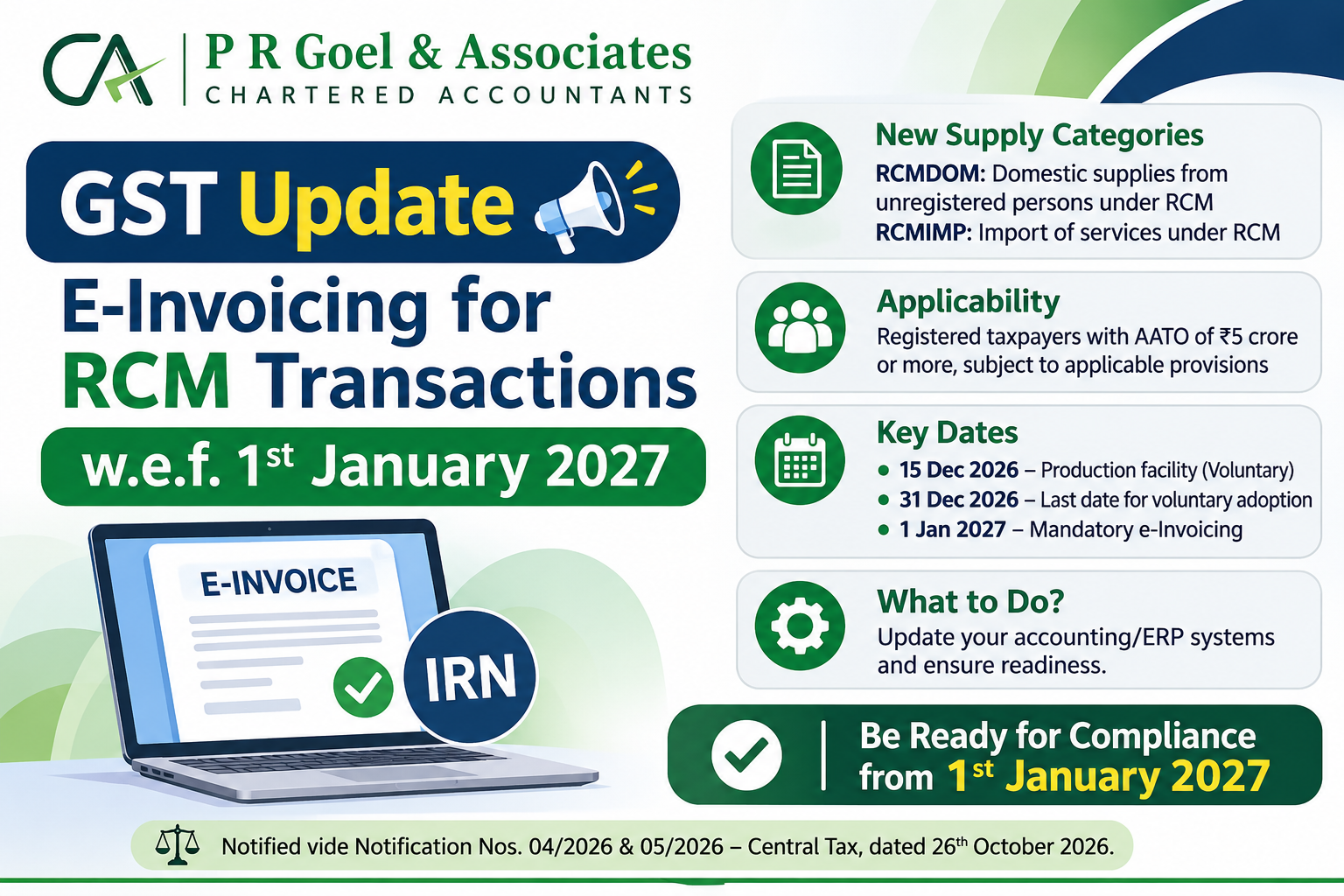
The Goods and Services Tax Network (GSTN) has announced a significant expansion of the e-invoicing framework under GST. With effect from 1st January 2027, e-invoicing will also cover recipient-generated self-invoices relating to specified domestic supplies received from unregistered persons under the Reverse Charge Mechanism (RCM) and import of services.
This development follows the recommendations of the 57th GST Council meeting and subsequent notifications issued by the Government. The objective is to bring recipient-generated invoices under the digital reporting framework and strengthen transparency and compliance in RCM transactions.
The Government has introduced two new supply categories, namely RCMDOM and RCMIMP, for reporting these transactions through authorised Invoice Registration Portals (IRPs).
1. What is the New E-Invoicing Requirement?
Under the existing GST e-invoicing framework, eligible registered suppliers are required to report specified B2B invoices and export invoices to an authorised Invoice Registration Portal (IRP) and obtain an Invoice Reference Number (IRN).
However, under the Reverse Charge Mechanism, the recipient is liable to pay GST instead of the supplier in specified cases. Consequently, the recipient may be required to issue a self-invoice in accordance with GST provisions.
To bring these recipient-generated invoices within the e-invoicing framework, GSTN has introduced two additional supply types:
| Supply Type | Description |
|---|---|
| RCMDOM | Recipient-generated self-invoices for domestic supplies received from unregistered persons where GST is payable under RCM. |
| RCMIMP | Recipient-generated self-invoices for import of services from suppliers located outside India where GST is payable under RCM. |
Accordingly, eligible registered recipients will be required to report such self-invoices through authorised IRPs and obtain IRNs.
2. Applicability of E-Invoicing
The new requirement is intended for registered taxpayers having Aggregate Annual Turnover (AATO) of ₹5 crore or more, subject to applicable statutory provisions and exemptions.
The applicability is linked to the existing e-invoicing framework under Notification No. 13/2020-Central Tax, as amended.
Businesses already covered under the e-invoicing provisions should examine their RCM transactions to identify whether they fall within the newly introduced reporting categories.
It is important to note that the applicability of e-invoicing does not automatically extend to every taxpayer paying GST under RCM. The relevant turnover threshold, statutory provisions and applicable exemptions must be considered.
3. E-Invoicing for Domestic Supplies from Unregistered Persons (RCMDOM)
Under the GST law, registered recipients are liable to pay GST under RCM on specified supplies received from unregistered suppliers.
In such cases, the recipient is required to issue a self-invoice in accordance with Section 31(3)(f) of the CGST Act, 2017, wherever applicable.
With the introduction of RCMDOM, eligible taxpayers will also be required to report these self-invoices through an authorised IRP and obtain an IRN.
Example:
Suppose a company covered under e-invoicing purchases specified goods or services from an unregistered supplier and GST is payable under RCM.
The company is required to:
- Identify the transaction as a domestic RCM transaction.
- Prepare the applicable self-invoice.
- Select the supply type code RCMDOM.
- Report the invoice details through an authorised IRP.
- Obtain the IRN and QR code against the self-invoice.
This will bring the recipient-generated self-invoice within the digital invoice reporting framework.
4. E-Invoicing for Import of Services (RCMIMP)
Import of services is another important category covered under the new e-invoicing framework.
Where a registered Indian business receives services from a supplier located outside India and GST is payable under RCM, the recipient will be required to report the applicable self-invoice using the newly introduced supply type RCMIMP, subject to the applicable provisions.
Example:
An Indian company obtains consultancy, software subscription, advertising or other taxable services from a foreign service provider.
Where the transaction qualifies as an import of services and GST is payable under RCM, the eligible recipient will be required to:
- Identify the transaction as an import of services.
- Prepare the applicable recipient-generated invoice.
- Select supply type code RCMIMP.
- Upload the prescribed invoice details to an authorised IRP.
- Obtain the IRN and QR code.
Businesses regularly making payments to overseas service providers should review their accounting and invoicing processes to incorporate this requirement.
5. Important Implementation Dates
GSTN has clarified the implementation schedule through its advisory dated 17 November 2026.
The important dates are as follows:
| Particulars | Date |
|---|---|
| Production facility proposed to be enabled | 15 December 2026 |
| Voluntary generation of IRNs | 15–31 December 2026 |
| Mandatory implementation | 1 January 2027 |
During the voluntary adoption period, eligible taxpayers may generate IRNs for genuine transactions falling under RCMDOM and RCMIMP.
Further, the production system will accept documents dated 15 December 2026 onwards for IRN generation under these two new categories.
It is important to understand that voluntary reporting during December 2026 does not change the notified mandatory implementation date of 1 January 2027.
6. Technical Implementation and Availability of Sandbox Facility
GSTN has confirmed that the new functionality has already been made available in the sandbox environments of all six authorised Invoice Registration Portals.
The sandbox facility enables taxpayers and technology partners to undertake development, integration and testing before the actual implementation.
The six authorised IRPs are:
| IRP | Portal |
|---|---|
| NIC IRP-1 | https://einvoice1.gst.gov.in |
| NIC IRP-2 | https://einvoice2.gst.gov.in |
| Cygnet IRP-3 | https://einvoice3.gst.gov.in |
| Clear IRP-4 | https://einvoice4.gst.gov.in |
| EY IRP-5 | https://einvoice5.gst.gov.in |
| IRIS IRP-6 | https://einvoice6.gst.gov.in |
7. Amendments to GST Notifications and E-Invoice Schema
The Government has issued the following notifications dated 26 October 2026:
Notification No. 04/2026-Central Tax
This notification amends Notification No. 13/2020-Central Tax to extend e-invoicing to:
- Supplies received from unregistered persons where GST is payable by the recipient under RCM.
- Import of services.
The amendment comes into effect from 1 January 2027.
Notification No. 05/2026-Central Tax
This notification provides corresponding amendments to the CGST Rules and the e-invoice schema.
The e-invoice schema, FORM GST INV-01, is being updated from Version 1.1 to Version 1.2, incorporating the two new supply type codes:
- RCMDOM
- RCMIMP
These changes provide the technical framework for reporting the newly covered transactions.
8. Practical Impact on Businesses
The new requirement may have a significant operational impact on businesses regularly entering into RCM transactions.
Businesses should particularly review the following areas:
A. Domestic Purchases from Unregistered Suppliers
Companies should identify specified domestic purchases from unregistered suppliers where GST is payable under RCM and examine the corresponding self-invoicing process.
B. Import of Services
Businesses receiving services from overseas vendors should review their foreign vendor transactions and identify those falling under RCM.
C. Accounting and ERP Systems
Accounting software and ERP systems should be updated to support RCMDOM and RCMIMP reporting, including the generation and recording of IRNs and QR codes.
D. Invoice Documentation
Finance and accounts teams should ensure that the prescribed invoice particulars are correctly captured before reporting invoices to the IRP.
E. Coordination with Vendors and Software Providers
Businesses should coordinate with their accounting software providers, GSPs and other technology partners to complete necessary system updates and testing well before the implementation date.
9. Compliance Checklist for Businesses
To ensure a smooth transition, businesses covered under the e-invoicing framework should consider the following preparatory activities:
- Review the applicability of e-invoicing based on aggregate annual turnover and applicable exemptions.
- Identify domestic purchases from unregistered suppliers attracting RCM.
- Identify import of services transactions attracting RCM.
- Review the existing process for preparation of recipient-generated self-invoices.
- Coordinate with ERP and accounting software providers for implementation of RCMDOM and RCMIMP.
- Complete sandbox testing and integration activities before the mandatory implementation date.
- Ensure that finance and accounts personnel are familiar with the new reporting requirements.
- Implement appropriate internal controls for IRN generation and invoice reconciliation.
10. Frequently Asked Questions (FAQs)
Q1. From when will e-invoicing for RCMDOM and RCMIMP become mandatory?
The requirement will become mandatory from 1 January 2027.
Q2. What is RCMDOM?
RCMDOM is the new supply type code for recipient-generated self-invoices relating to specified domestic supplies received from unregistered persons where GST is payable under RCM.
Q3. What is RCMIMP?
RCMIMP is the new supply type code for recipient-generated self-invoices relating to import of services where GST is payable under RCM.
Q4. Will all taxpayers registered under GST be covered?
No. The requirement is linked to the existing e-invoicing eligibility threshold of ₹5 crore AATO and is subject to applicable statutory provisions and exemptions.
Q5. Can businesses generate IRNs before 1 January 2027?
Yes. The production functionality is proposed to be enabled from 15 December 2026. Eligible taxpayers may voluntarily generate IRNs between 15 December and 31 December 2026.
Q6. Can sample transactions be tested on the production portal?
No. Sample data should be used only in the sandbox environment. The production environment must be used only for genuine transactions.
Q7. Will there be any change in the existing RCM tax liability?
The new requirement primarily extends the e-invoicing and invoice reporting framework. It does not, by itself, change the underlying RCM liability, applicable tax rates or conditions for claiming input tax credit.
Conclusion
The introduction of RCMDOM and RCMIMP marks an important expansion of the GST e-invoicing framework. By bringing recipient-generated self-invoices for specified domestic RCM supplies and import of services within the IRN reporting system, the Government aims to strengthen digital reporting and compliance.
Businesses having an AATO of ₹5 crore or more should proactively review their domestic RCM purchases and import of services transactions and coordinate with their accounting and ERP service providers to ensure timely implementation.
Since the mandatory requirement comes into effect from 1 January 2027, businesses should complete the necessary system development, integration and testing activities well in advance to avoid last-minute compliance challenges.
For professional assistance relating to GST compliance, RCM advisory, e-invoicing implementation and accounting system readiness, you may contact P R Goel & Associates, Chartered Accountants.
Disclaimer: This article is intended for general informational purposes and should not be construed as professional or legal advice. Applicability should be determined with reference to the relevant GST notifications, rules, circulars and exemptions.