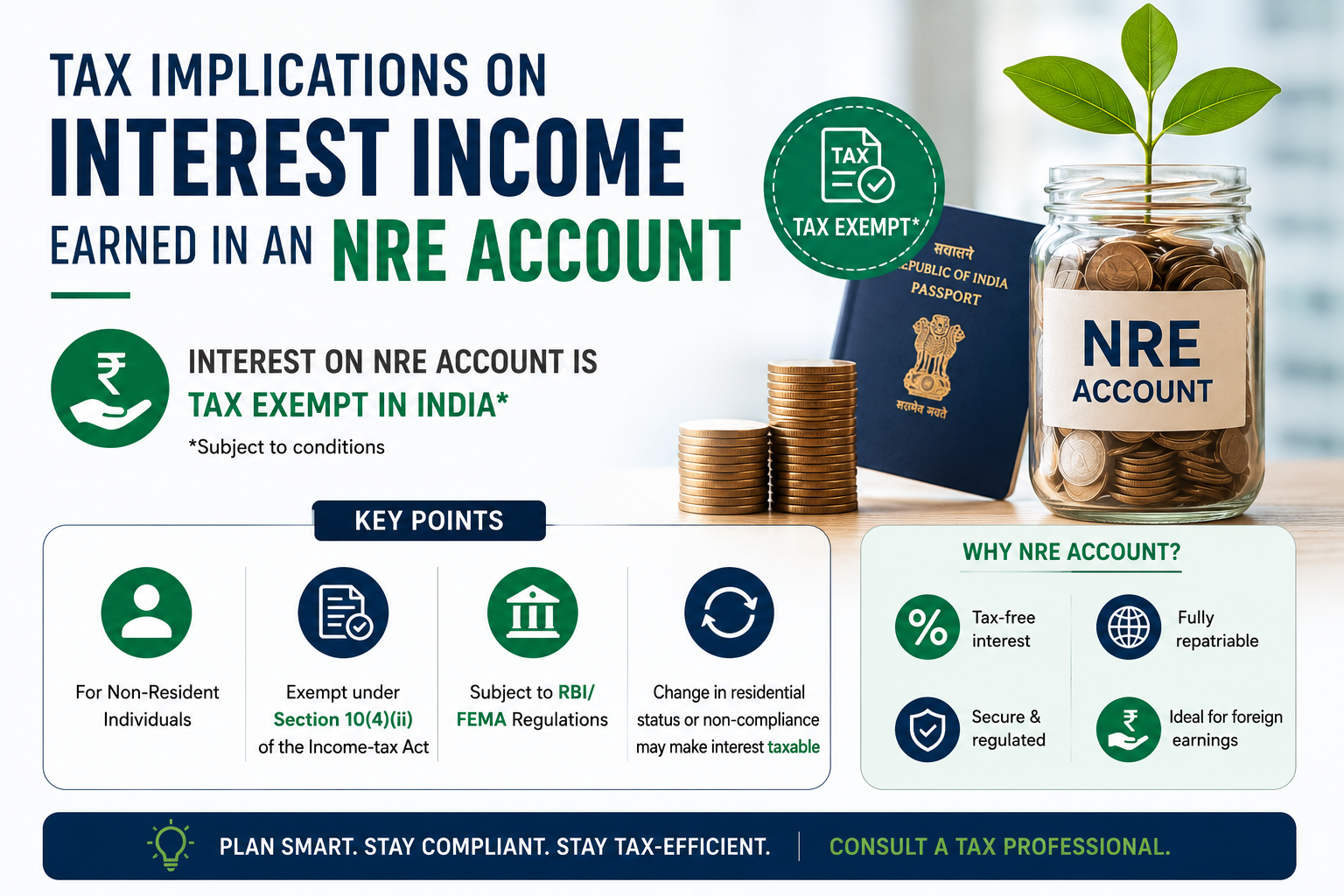
Tax Implications on Interest Income Earned in an NRE Account: A Complete Guide for NRIs
Is Interest Earned on an NRE Account Taxable in India?
For Non-Resident Indians (NRIs), an NRE (Non-Resident External) Account is one of the most preferred banking options for managing income earned outside India. Apart from offering complete repatriability of funds, one of the biggest advantages of an NRE Account is the tax exemption available on the interest earned.
However, this exemption is subject to certain conditions under the Income-tax Act, 1961 and the Foreign Exchange Management Act, 1999 (FEMA). Any change in residential status or non-compliance with the applicable provisions may result in the interest becoming taxable.
In this article, we explain the tax implications on interest earned in an NRE Account, the legal provisions governing the exemption, and the situations where the exemption may cease to apply.
What is an NRE Account?
A Non-Resident External (NRE) Account is a rupee-denominated bank account maintained by an NRI to deposit income earned outside India. The account allows NRIs to hold foreign earnings in Indian Rupees while enjoying full repatriability of both principal and interest.
Key features include:
- Maintained only by Non-Resident Indians (NRIs) and Persons of Indian Origin (PIOs), subject to applicable regulations.
- Deposits are made through foreign remittances or transfers from other eligible NRE/FCNR accounts.
- Both principal and interest are generally freely repatriable outside India.
- Interest earned is eligible for tax exemption, subject to fulfillment of prescribed conditions.
Is Interest on an NRE Account Taxable?
Under Indian tax laws, interest earned on an NRE Savings Account or NRE Fixed Deposit is generally exempt from income tax.
The exemption is available only when the following conditions are satisfied:
- The account holder qualifies as a “person resident outside India” under FEMA.
- The individual continues to be a Non-Resident for income-tax purposes.
- The account is maintained in accordance with FEMA and RBI regulations.
When these conditions are fulfilled, the interest earned does not form part of the taxable income in India.
Relevant Legal Provision
The exemption is provided under Section 10(4)(ii) of the Income-tax Act, 1961.
The provision exempts:
Interest on money standing to the credit of an individual in a Non-Resident External (NRE) Account in any bank in India, provided the individual is a person resident outside India as defined under FEMA.
Thus, the exemption is linked not merely to the type of account but also to the residential status of the account holder.
Conditions for Claiming Tax Exemption
To enjoy tax-free interest on an NRE Account, the following conditions should be fulfilled:
1. The Account Holder Must Be an Individual
The exemption is available only to individuals maintaining eligible NRE accounts.
2. Residential Status Under FEMA
The account holder should qualify as a person resident outside India under FEMA.
3. Compliance with RBI Regulations
The account should be maintained strictly in accordance with RBI guidelines governing NRE accounts.
4. Valid NRE Account
The account should continue to qualify as an NRE account throughout the relevant period.
What Happens When Residential Status Changes?
One of the most common issues arises when an NRI returns to India permanently.
After becoming a resident:
- The NRE account cannot continue indefinitely in its existing form.
- The account should be redesignated as a resident account or converted into another permissible account as per RBI regulations.
- The tax exemption available under Section 10(4)(ii) generally ceases once the prescribed conditions are no longer satisfied.
- Interest earned thereafter may become taxable in India, subject to the applicable provisions of the Income-tax Act.
Therefore, returning NRIs should promptly review and update their banking arrangements to avoid unintended tax consequences.
Is Tax Deducted at Source (TDS)?
Where the interest remains exempt under Section 10(4)(ii), banks generally do not deduct TDS on such interest.
However, if the exemption is no longer available due to a change in status or non-compliance with applicable provisions, the tax treatment may change depending on the nature of the account and the relevant legal provisions.
Difference Between NRE and NRO Account Taxation
| Particulars | NRE Account | NRO Account |
|---|---|---|
| Source of Funds | Foreign income | Indian income and permissible foreign income |
| Interest Income | Generally exempt under Section 10(4)(ii), subject to conditions | Taxable in India |
| TDS | Generally not applicable while exemption is available | TDS applicable as per law |
| Repatriability | Fully repatriable (subject to regulations) | Subject to prescribed conditions and limits |
Understanding this distinction is important while planning investments and managing banking arrangements in India.
Common Mistakes Made by NRIs
Many NRIs unintentionally lose the tax benefits available on NRE Accounts due to avoidable mistakes, such as:
- Continuing to operate an NRE Account after becoming a resident in India without redesignation.
- Assuming that every bank account held by an NRI is automatically tax-free.
- Not updating residential status with the bank.
- Ignoring FEMA compliance requirements.
- Believing that all interest earned by NRIs is exempt from tax.
Regular review of banking arrangements helps ensure continued compliance.
Frequently Asked Questions (FAQs)
Is interest on an NRE Savings Account taxable?
Generally, no. Interest is exempt under Section 10(4)(ii), subject to fulfillment of the prescribed conditions.
Does the exemption apply to NRE Fixed Deposits?
Yes. Interest on eligible NRE Fixed Deposits is also generally exempt, subject to the same conditions.
Is TDS deducted on NRE Account interest?
Generally, banks do not deduct TDS where the interest qualifies for exemption under Section 10(4)(ii).
What if I become a resident in India?
The continued availability of the exemption depends on compliance with the applicable legal framework. The account should be redesignated in accordance with RBI regulations, and the tax implications should be evaluated based on the changed residential status.
Should NRIs disclose exempt interest in the Income-tax Return?
Depending upon the applicable return form and reporting requirements, exempt income may need to be disclosed even though it is not taxable.
Conclusion
The tax exemption available on interest earned in an NRE Account is one of the most significant benefits available to NRIs. However, the exemption is conditional and closely linked to the account holder’s residential status and compliance with FEMA and RBI regulations.
A change in residential status, failure to redesignate accounts, or non-compliance with regulatory requirements can alter the tax treatment of such interest. Accordingly, NRIs should periodically review their banking arrangements and residential status to ensure continued eligibility for the exemption.
Professional advice can help avoid unnecessary tax exposure, ensure regulatory compliance, and optimize tax-efficient financial planning.
How P R Goel & Associates Can Help
At P R Goel & Associates, we assist NRIs with:
- Tax advisory on NRE, NRO, and FCNR accounts
- Residential status determination
- Income-tax return filing for NRIs
- FEMA and RBI compliance advisory
- Tax planning for returning Indians
- Advisory on disclosure of foreign assets and overseas income
If you require assistance regarding NRI taxation or wish to evaluate the taxability of your bank interest in India, our team would be happy to assist.