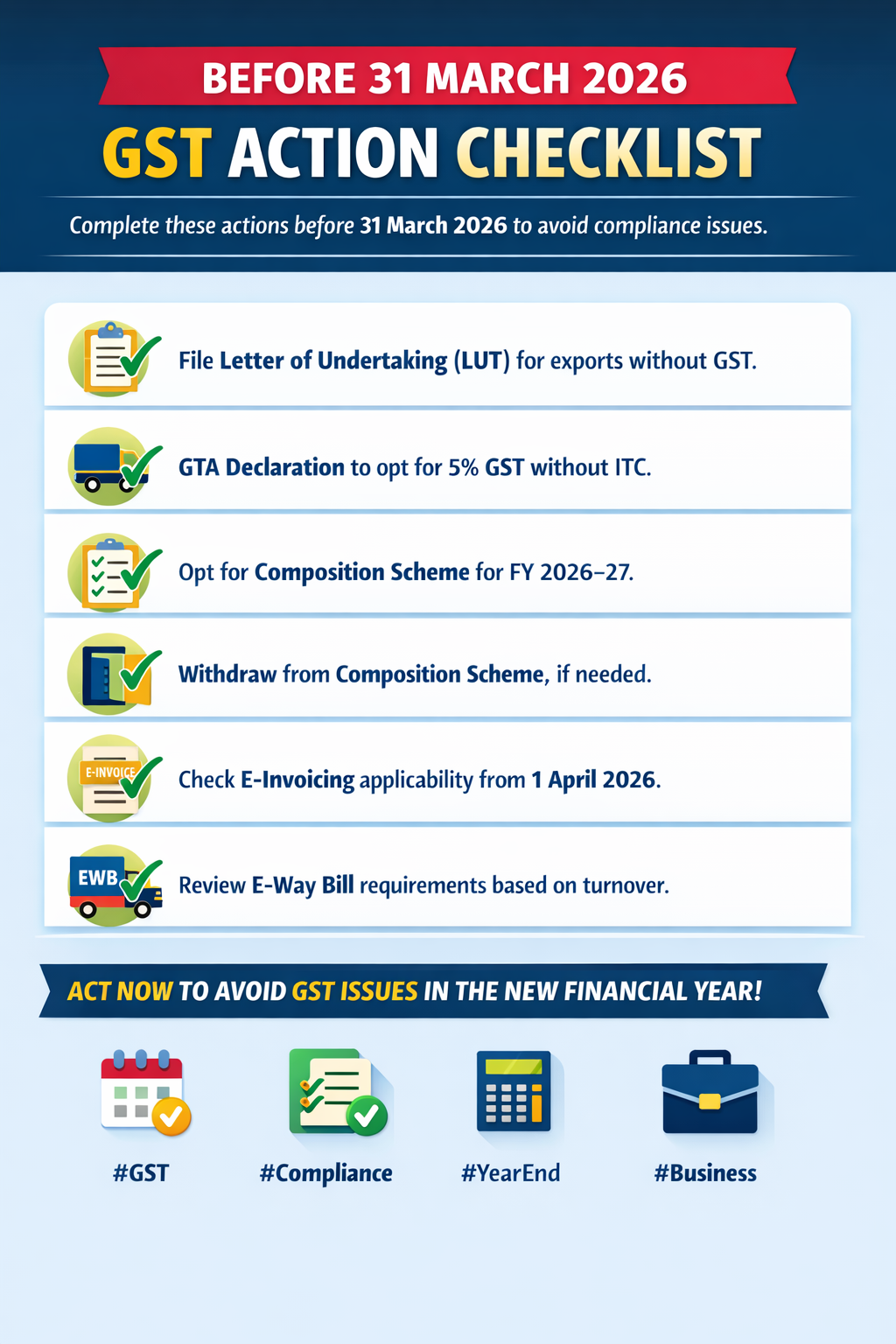
GST Year-End Compliance: Important Actions to Complete Before 31 March 2026
As the financial year 2025–26 draws to a close, businesses registered under the Goods and Services Tax (GST) should review certain statutory declarations and compliance options that must be exercised before the start of the next financial year.
Many GST provisions operate on a financial-year basis, which means that taxpayers must exercise options or submit declarations before 31 March 2026 to ensure smooth compliance from 1 April 2026.
Failure to review these items may lead to operational disruptions, loss of tax benefits, or additional compliance burdens in the new financial year.
This article highlights the key GST actions businesses should consider completing before 31 March 2026.
1. Filing of Letter of Undertaking (LUT) for Exporters
Businesses exporting goods or services without payment of tax must furnish a fresh Letter of Undertaking (LUT) for every financial year.
Under GST law, exporters can choose between two methods:
- Export with payment of IGST and later claim a refund.
- Export without payment of tax by filing an LUT.
Most exporters prefer the LUT option because it prevents working capital from getting blocked in tax payments and refund processes.
Validity of LUT
The LUT filed under GST remains valid only for the financial year in which it is submitted, and exporters must file a fresh LUT every year to continue exporting without payment of IGST.
For example:
| Financial Year | LUT Validity |
|---|---|
| FY 2025–26 | Valid until 31 March 2026 |
| FY 2026–27 | Fresh LUT required |
If exports are made without filing a new LUT for the upcoming financial year, the exporter may be required to pay IGST on such supplies.
Who Should File LUT
- Exporters of goods
- Exporters of services
- Suppliers to SEZ units or SEZ developers
The LUT is filed electronically through the GST Portal using Form GST RFD-11.
2. Declaration by Goods Transport Agency (GTA)
Under GST, services provided by a Goods Transport Agency (GTA) are subject to different taxation options.
A GTA may opt to pay GST under either of the following:
| GST Rate | ITC Availability |
|---|---|
| 5% | No Input Tax Credit |
| 12% | Input Tax Credit available |
Transporters opting for 5% GST without ITC are required to submit a declaration before the beginning of the financial year.
Why This Declaration Is Important
The declaration determines how the tax will be paid on GTA services during the entire financial year. Failure to submit the declaration may result in the default tax structure being applied.
Transport businesses should review their input tax credit position and choose the option that best suits their business model.
3. Opting for the Composition Scheme
Small taxpayers may opt for the Composition Scheme to simplify their GST compliance.
The composition scheme offers several benefits, including:
- Lower tax rates
- Simplified compliance requirements
- Quarterly return filing
- Reduced documentation
However, certain conditions must be satisfied to opt for the scheme.
Eligibility Conditions
- Aggregate turnover within the prescribed threshold
- Limited types of permitted business activities
- No interstate supply of goods or services (with certain exceptions)
Businesses wishing to opt for the composition scheme for FY 2026–27 must submit the required intimation before the start of the financial year through Form CMP-02.
4. Withdrawal from Composition Scheme
Businesses already registered under the composition scheme may need to withdraw from the scheme if:
- Their turnover exceeds the prescribed limit
- They begin making interstate supplies
- They wish to claim input tax credit
- They expand operations requiring regular GST compliance
In such cases, the taxpayer should file the necessary intimation for withdrawal before the beginning of the new financial year.
Early withdrawal helps ensure a smooth transition to the regular GST scheme.
5. Review Applicability of E-Invoicing
Businesses should review whether E-Invoicing will become applicable to them from 1 April 2026 based on their aggregate turnover.
E-invoicing requires invoices to be generated through the Invoice Registration Portal (IRP), which validates the invoice and generates a unique Invoice Reference Number (IRN).
Why This Review Is Important
If e-invoicing becomes applicable to a business and the company fails to comply:
- The invoice may be treated as invalid
- Input tax credit may be denied to customers
- Businesses may face penalties under GST
Therefore, companies approaching the turnover threshold should prepare their accounting or ERP systems in advance.
6. Review E-Way Bill Compliance
Businesses must also review the applicability of the E-Way Bill system.
An e-way bill is required when goods are transported and the value exceeds the prescribed limit.
At year-end, businesses should evaluate:
- Whether turnover changes impact compliance
- Whether additional branches require e-way bill registration
- Whether internal logistics systems comply with GST rules
Ensuring proper e-way bill compliance prevents delays in the movement of goods and avoids penalties.
Why These GST Actions Should Be Completed Before 31 March
Completing these compliance actions before the financial year ends offers several advantages:
1. Smooth Transition to the New Financial Year
Businesses can start FY 2026–27 without disruptions.
2. Avoidance of Unnecessary Tax Payments
Timely filing of LUT prevents exporters from paying IGST on exports.
3. Better Tax Planning
Businesses can choose the most beneficial tax structure.
4. Avoidance of Compliance Risks
Early action reduces the risk of penalties, notices, or operational issues.
Conclusion
As the financial year 2025–26 comes to an end, businesses should proactively review their GST obligations and ensure that all relevant declarations and options are exercised before 31 March 2026.
Key actions include:
- Filing LUT for exporters
- GTA tax option declaration
- Opting or withdrawing from the composition scheme
- Reviewing applicability of e-invoicing
- Checking e-way bill compliance
By addressing these matters in advance, businesses can ensure smooth GST compliance from 1 April 2026 and avoid unnecessary tax or procedural complications.
About Us
P R Goel & Associates provides professional advisory services in GST compliance, tax planning, and regulatory matters to businesses across India.
If you require assistance with GST compliance or year-end review, feel free to contact our team.